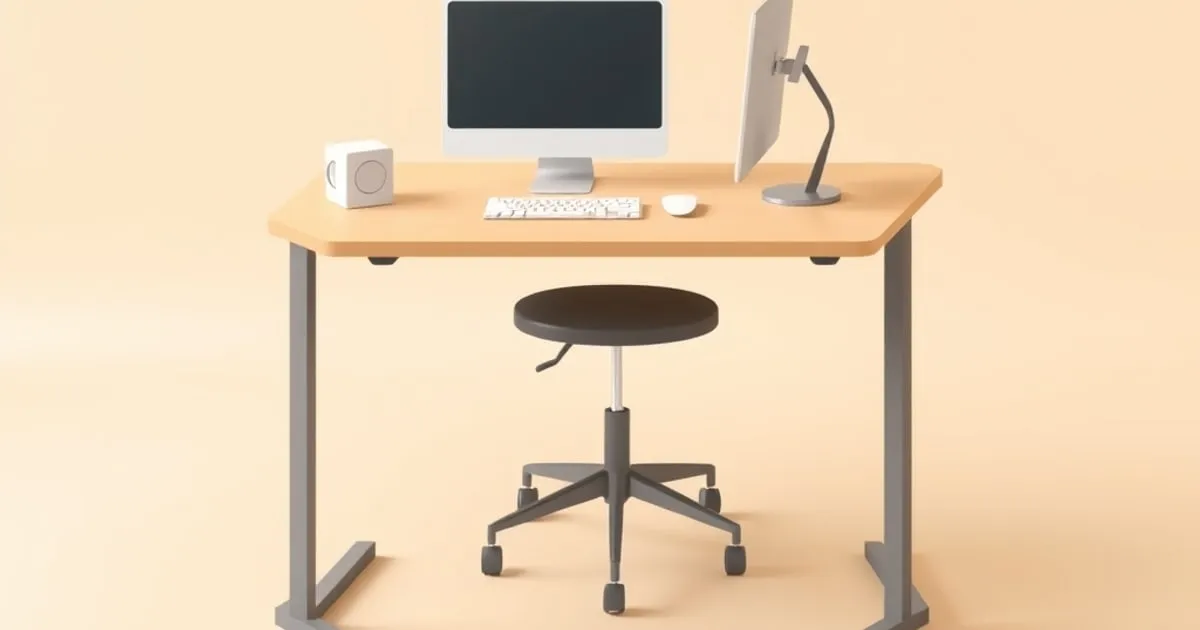
Desk Chair Height: Set the Chair Before the Desk
Desk chair height is the first measurement in a workstation, not the last. Find your seat number, then set the desk, keyboard and monitor around it.
Most people set up a workstation from the desk down. That is backwards, and it is why so many carefully measured desks still produce sore shoulders. Desk chair height is the reference datum for everything else: the chair decides where your elbows sit, your elbows decide where the keyboard must sit, and the keyboard decides the desk. Set the desk first and you have fixed the wrong variable.
The number you are looking for is straightforward. This site’s planning estimate uses 25% of standing height for seat height. Treat it as an assumption to check against foot support and seat pressure, not a guaranteed fit. For a 5’8” (173 cm) person that is about 43 cm, or 17 inches. Everything in this guide is the sequence that follows from that one measurement, and what to do when a fixed desk refuses to cooperate.
Why Chair First
OSHA’s chair guidance starts with the same order of operations: seat height adjustable so the whole sole of the foot rests flat, backrest reclining at least 15 degrees, lumbar support adjustable in height. None of those depend on the desk. All of them change where your hands end up.
The dependency runs one way. Raise the chair by 3 cm and your elbows rise 3 cm, so the correct keyboard height rises 3 cm. Raise the desk by 3 cm and nothing about your body changes; you have simply made the desk wrong. That asymmetry is the whole argument for the sequence below.
Step 1: Seat Height
Seat height relates to popliteal height, the distance from the floor to the back of the knee. The table below applies the illustrative 0.250 stature ratio used on this site; it is not an OSHA specification.
| Your height | Seat height (natural) |
|---|---|
| 5’0” (152 cm) | 38 cm (15.0 in) |
| 5’2” (158 cm) | 39 cm (15.5 in) |
| 5’4” (163 cm) | 41 cm (16.0 in) |
| 5’6” (168 cm) | 42 cm (16.5 in) |
| 5’8” (173 cm) | 43 cm (17.0 in) |
| 5’10” (178 cm) | 44 cm (17.5 in) |
| 6’0” (183 cm) | 46 cm (18.0 in) |
| 6’2” (188 cm) | 47 cm (18.5 in) |
| 6’4” (193 cm) | 48 cm (19.0 in) |
Verify it rather than trusting the number. OSHA’s test is that the entire sole of each foot rests on the floor with the back of the knee slightly higher than the seat: sit fully back, feet flat, thighs roughly horizontal, no pressure ridge under the thighs and no need to point your toes. If you wear shoes at your desk, measure in them.
Two adjustments belong in the same step. Seat depth should leave two to three finger-widths between the front edge of the seat and the back of your knee; too deep creates edge pressure, too shallow shifts load into the lower back. Backrest angle should not be 90 degrees. Cornell’s workstation guidance is blunt about this: the best seated posture is a reclined 100 to 110 degrees, not upright, because reclining measurably reduces postural muscle activity and lumbar disc pressure. Erect sitting is not relaxed sitting.
If the chair itself is the limiting factor — fixed lumbar, no seat slider, no meaningful recline — the setup guide to desk chair height and lumbar position covers how the support and keyboard reach should work together.
Step 2: Desk Height, Derived From the Chair
With the chair set, measure seated elbow height above the floor. Subtract the keyboard’s home-row height above the desk to find an initial desktop setting. The site’s illustrative body-height model estimates seated elbow height as 0.395 of stature, but a direct measurement should take priority. A hypothetical 3 cm keyboard needs a surface 3 cm below the measured elbow level.
For most adults the result lands between 58 and 74 cm (23 to 29 in), which is below the 71 to 76 cm that fixed desks are manufactured at. The full breakdown by height is in the guide to the best desk height for ergonomics, and the standing equivalent is in the standing desk height chart. To skip the arithmetic entirely, the desk height calculator at ErgoRanker provides interactive starting estimates.
Step 3: The Footrest Decision
Here is where the chair-first order pays off. If your desk is fixed and too high, you do not lower your arms to meet it — you raise the chair until your elbows meet the keyboard, and then you deal with your feet.
Measure the gap after raising the occupied chair to reach the keyboard. A footrest should restore full foot support without pushing the knees into the underside of the desk.
There is no fixed footrest height for a given stature. Seat compression, shoe height, desk height and keyboard thickness all affect the result. Recheck the whole arrangement when one of those changes.
OSHA’s chair guidance treats foot support as part of the seated fit. Use a stable support with enough room for both feet and check that it remains in position through normal movement.
Step 4: Keyboard Angle
Once the height is right, the tilt matters. Flip-out keyboard feet raise the back edge and push your wrists into extension, which is the opposite of what you want. Fold them down. Cornell’s guidance goes further and recommends a negative tilt — the keyboard sloping slightly away from you — for the best wrist posture, which is what a proper keyboard tray provides and a desk surface cannot.
Armrests need a decision too, and it is not the obvious one. Cornell notes that permanently resting your forearms on armrests while typing compresses the flexor muscles and can compress the ulnar nerve at the elbow. Armrests are for getting in and out of the chair and for resting between bouts of typing; they should be easy to move out of the way rather than something you type from.
Step 5: Monitor Height, Last
The monitor is set last because it depends on where your eyes ended up, which depends on the chair. Cornell’s target is that your eyes line up with a point on the screen about 2 to 3 inches below the top of the monitor casing — the casing, not the top of the glass — with the screen directly in front of you and tilted slightly back so it is perpendicular to your line of sight.
That is easy to say and awkward to do with a stock monitor stand, which typically offers a few centimetres of travel and no tilt worth the name. A VESA arm such as the Ergotron LX decouples screen height from desk height entirely, which matters most if you ever change the chair, share the desk, or move between sitting and standing. The geometry — viewing distance, tilt, dual-monitor angles — is worked through in monitor placement and lighting for long sessions.
Four Mistakes This Order Prevents
Lowering the chair to reach a low desk. Sinking the seat drops the knees above hip height, rotates the pelvis backwards, and flattens the lumbar curve. The desk was the problem; the chair pays for it.
Setting seat height from thigh comfort alone. A seat that feels pleasant can still be an inch off the height your elbows need. Comfort at minute one and posture at hour six are different measurements.
Using armrests as a wrist rest. Different structure, different job, and a nerve compression risk in between.
Buying the chair last. The chair is the only component that adapts to your body rather than the room. A cheap chair under a perfect desk produces a worse workstation than a chair that supports you at a compatible desk. The budget setup guide explains how to spend against an identified fit problem.
Once all five steps are set, run the ergonomic desk setup checklist to confirm the result in your actual room rather than on paper. If the budget for fixing any of this is close to zero, desk ergonomics on a budget covers the versions that cost nothing.
FAQ
What height should my desk chair be?
Roughly 25% of your standing height: about 41 cm (16 in) at 5’4”, 43 cm (17 in) at 5’8”, and 46 cm (18 in) at 6’0”. Confirm it by checking that the whole sole of each foot is flat on the floor, your thighs are roughly horizontal, and the back of the knee sits a touch higher than the seat — measured in the shoes you actually wear at the desk.
Should the chair be higher or lower than the desk?
Neither directly. Set the chair to fit your legs, then set the desk so the keyboard’s home row meets your elbows. If the desk is fixed and too high, raise the chair to meet it and add a footrest to restore foot contact rather than dropping your arms.
How do I know if my chair is too low?
Knees sitting above hip height, a tendency to slide forward on the seat, and reaching upward to the keyboard are the three signals. A low chair rotates the pelvis backwards and flattens the lumbar curve, which is a common driver of end-of-day lower back ache.
Is 90 degrees the correct backrest angle?
No. Cornell’s ergonomics guidance recommends a reclined 100 to 110 degrees, because reclining transfers load into the backrest and produces measurable reductions in postural muscle activity and lumbar disc pressure. Upright sitting is held, not supported.
Do I need a footrest?
Use foot support when the occupied chair position leaves your feet unsupported. Measure the actual gap after setting the keyboard relationship; body height alone cannot determine a footrest size.
Related across the network
- How to Choose an Ergonomic Chair: A Spec Checklist — ergochairguide.com
Sources
Related

Best Desk Height for Ergonomics: How to Measure
The best desk height for ergonomics depends on your body, not one spec. Learn the elbow-measurement method and how to fix a desk that's the wrong height.

Standing Desk Height Chart and Formula by Body Height
Use a standing desk height chart in cm and inches, see the elbow-height formula, and adjust the surface for your keyboard, shoes and standing mat.

Ergonomic Desk Setup Checklist: Measure Twice, Adjust Once
Work through an ergonomic desk setup checklist for chair height, keyboard reach, monitor position, small rooms, lighting and a staged buying plan.